
Case Study SIXTEEN
Michel-Jack Chasseuil’s Rare Capstone
This is a Capstonea story told well yet a conundrum still remains
“This is the amazing story of the world’s greatest collection of rare wines and the unlikely collector who built it….
Harbouring a relentless pursuit of the most impossible to find vintages and investing nearly every penny he has ever had, Michel has been quietly and patiently collecting fine wine gold. For Michel, wine is everything.”
- Rare Wine Documentary

INTRODUCTION ~ The ‘Louvre of Wine’ ~
“Harbouring a relentless pursuit of the most impossible to find vintages and investing nearly every penny he has ever had, Michel has been quietly and patiently collecting fine wine gold. For Michel, wine is everything… beneath his old farmhouse, Michel has built with his own two hands something extraordinary… but a 50-year Capstone project all about preserving the world’s best wine now faces the next chapter in its story…. What to do with one man’s accumulation of 50,000 iconic bottles… worth… $200m…. “
MICHEL-JACK CHASSEUIL’S UNLIKELY YET EXTRAORDINARY WINE CAPSTONE
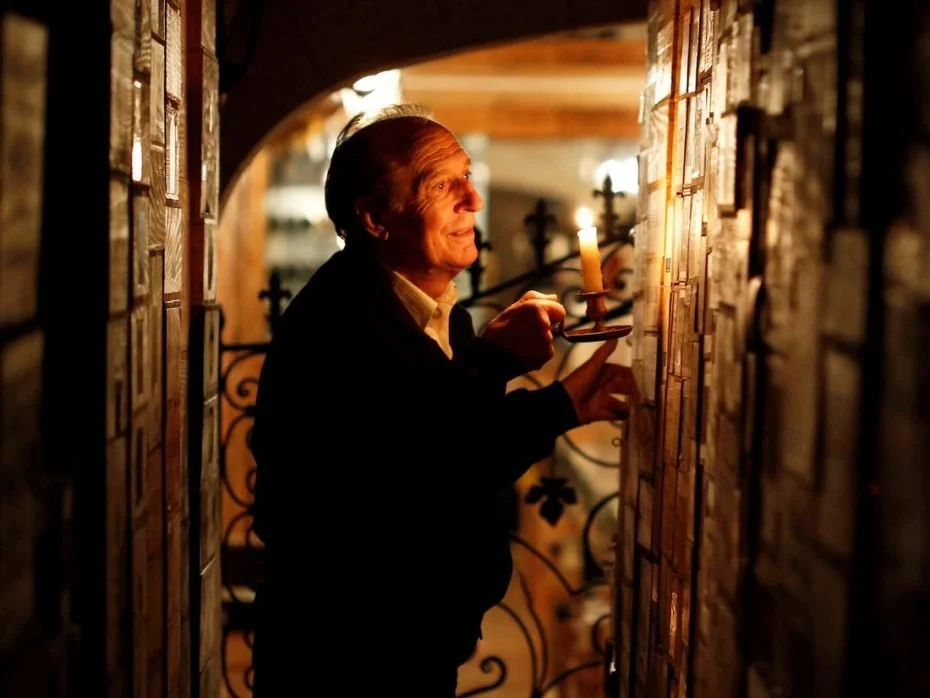
Frenchman Michel-Jack Chasseuil (MJC) has harboured a Capstone project for over 50 years. Retiring from his at the age of 47, MJC shifted his time, energy and resourcefulness to collecting rare wine. For decades, MJC has ploughed on, carrying out his vision, to create ‘the Louvre of Wine’.
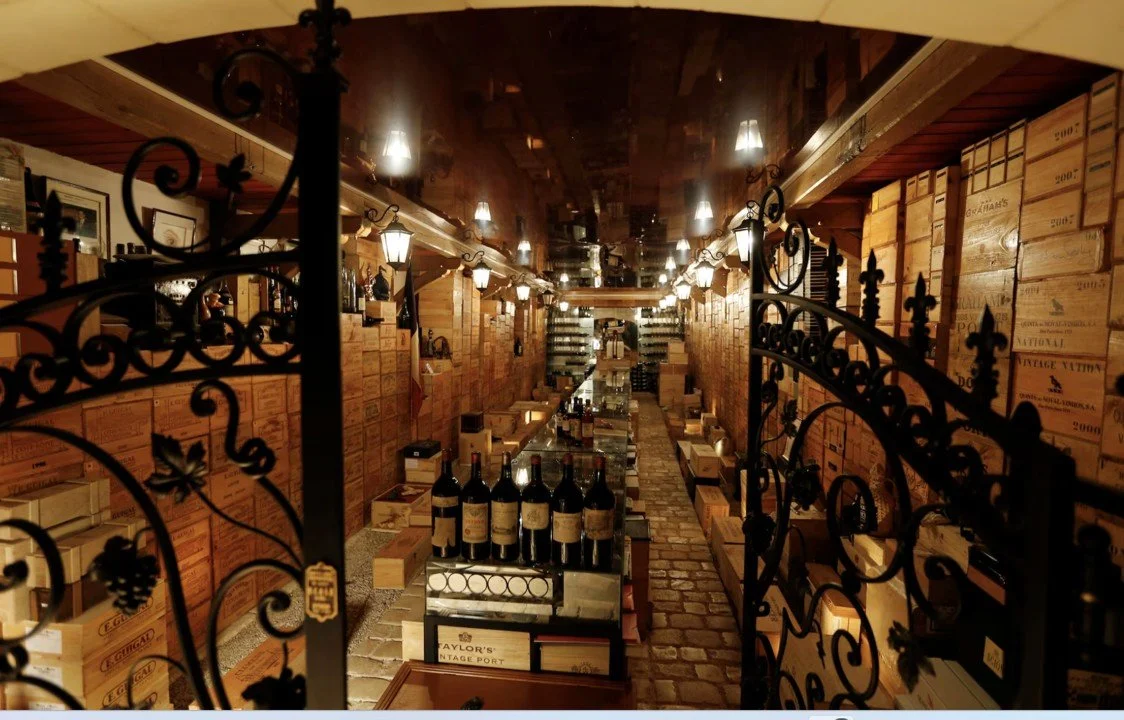
The result… over 50,000 of the most sought-after wine bottles in the world housed in a cellar built himself, underneath MJC’s unassuming house in the middle of rural France. A collection considered impossible to recreate; an accumulation even a billionaire would struggle to access and buy such coveted wine. Upon hearing, wine leaders are left dumbfounded as to how MJC has managed to procure such rarity. But for MJC its certainly not about the money or curation for curations’ sake. It has been a passion project that he has devoted his life post-Keystone career to… 12 hours a day, 7 days a week… all in the name of preservation. A Capstone driven by his desire to safeguard rare wine to last for generations to come. Collecting and preserving the finest wine in all the world… honouring and celebrating the world’s most talented winemakers.
The genie is about to be let out of the bottle... A mainstream documentary is about to hit the screens soon, and it looks awesome. MJC has many offshoot stories from the main narrative that defy belief/ amaze…. It is great that MJC’s chronicle (and his sub-stories) will be seen by millions, inspiring others to start or persevere with their Capstone project. However, with the success and spotlight will also come challenges. Now, the dream that fuelled Michel-Jack Chasseuil for half a century faces its ultimate test...
CORNERSTONE PHASE
MJC was born in 1941, raised in a small rustic village in France. He was a clever child, passing his elementary school certificate “certificate d’etudes primaires” at the age of 14 going onto a technical boarding school Collège de Breloux la Crèche. Four years later he studied in France and by 1960, aged nineteen, he had graduated with two degrees, one in coppersmith, the other as an aeronautical technician.
During his education, MJC remembers at the age of nine his grandfather buying a farm in Deux-Sèvres, Western France. MJC recalls that at the start of each year, his Grandfather would gift him and his siblings 100 bottles of wine. This early exposure and generosity sparked a curiosity and fondness in MJC around wine.
KEYSTONE
~ Breaking the system ~
MJC’s first job was in Niort, as a draftsman/ industrial designer in 1960, but soon he was drafted for military service during the Algerian War. MJC recalls it was also the first time he remembers enjoying tasting wine. After three years of service, MJC joined Dassault, the French manufacturer of military aircraft and business jets. The company is most known for its combat aircrafts such as Mirage, Falcon and Rafale. It was the start of a 27-year career at Dassault for MJC- from 1963 to 1989. In the early 1970s MJC worked in the Foreign Sales Department. MJC believed his boss was a spy working covertly for the Mossad, dying suspiciously in a hunting accident in 1975. More stories around this are relayed in the documentary than we will focus on here… Life seems to be anything but dull around MJC. It is also safe to say MJC was not lucky in love. He met his wife Annie, marrying and living in South Africa in 1967. Four years later their son Jeremy was born. The marriage ended in divorce in 1974, with Annie leaving MJC for another lover (having an affair with her boss at work). MJC won custody of Jeremy the same year and bought the house from his grandmother for 6,000 Euros. It wasn’t until 1989 that MJC would move to the house when he retired from his career at Dassault.
Further crazy stories ensue during MJCs keystone phase of life. Again, we will not dwell on those here- the documentary covers when MJC ran the New York Marathon in 1979, resulting in him rescuing a French lady, Madame Mary Domergue, bringing her back to France where she would live with MJC for the rest of her life. In her will she left half of a Pomerol vineyard, the well-regarded Chateau Feytit-Clinet to MJC. Jeremy was able to acquire the other half of the 6.5-hectare estate and has been running the Bordeaux vineyard ever since.
THE START OF MJC’s WINE COLLECTING
During MJCs career he had a sociable roll- entertaining government clients, enabling him to learn and try great wines whilst hosting. MJC bought his first case of Grand Cru Classé, in 1970, which was from Chateau Dassault, the wine Capstone of Marcel Dassault, the founder of Dassault Aviation who bought and renamed Chateau Couperie in 1955. MJC began going to wine auctions in Paris to observe and learn. 1972 was when MJC reports he officially started his wine collection.
1998 brought about the end of MJC’s career at Dassault, at the age of 47 MJC retired from aerospace and engineering.
CAPSTONE
~ A 50-year wine obsession (and still going) ~
MJC quickly got to work building his ‘alcoholarium’ in 1989, the start of what he considers his real collection. By 1990, he had over 1000 bottles of wine, visiting Vinexpo in Bordeaux and meeting the likes of wine world great Michael Broadbent inspiring him. The cellar, inconspicuously built, is underneath his family home.
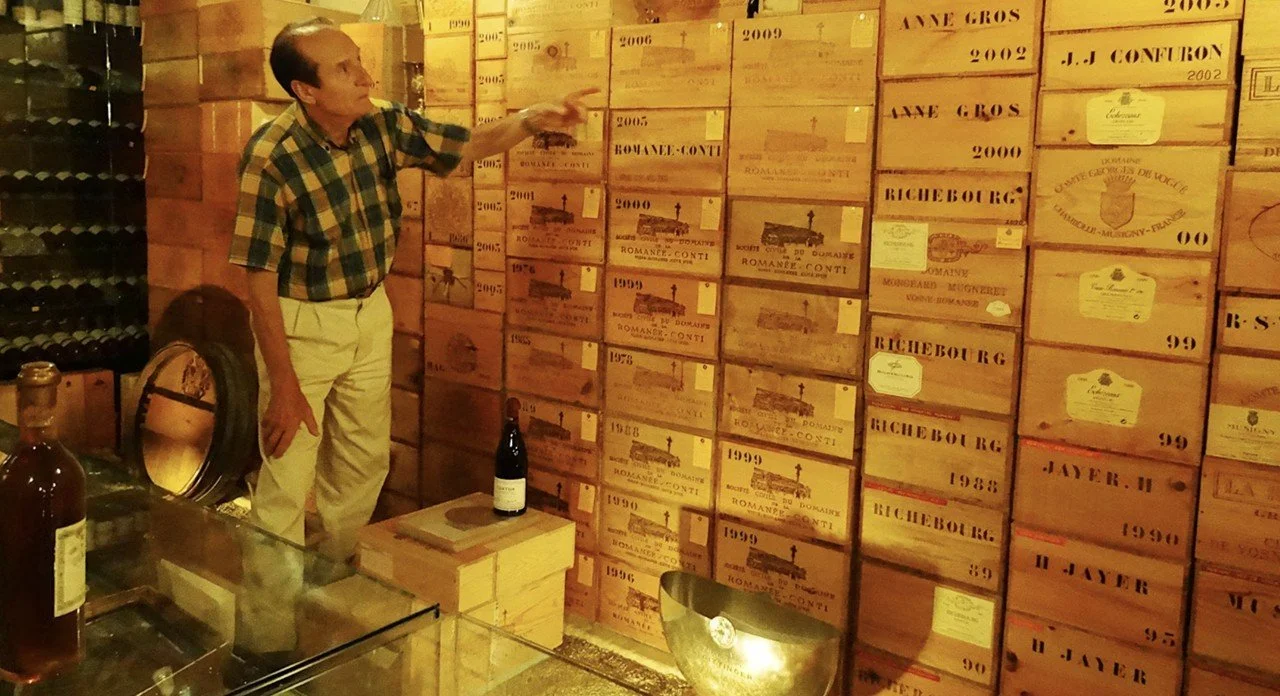
2000, MJC built the second cellar and also started collecting Robert Parker 100-point wines. He would usually travel inside of France to obtain his wine especially Paris but also collected wine from the likes of Bolgheri and Napa Valley. By 2012 he had 8-10,000 bottles of wine… By 2020 he needed to extend, digging and constructing himself (at the age of 79 no less) adding an additional 350 sq. metres to his cellar. It was to house his collection of over 50,000 bottles of wine…Valued at over $200 million.
His collection spans the best 250 or producers from around the world. Every year of Petrus and Romanee Conti since 1904 and 1914 respectively. It is thought that MJC is storing wine in his collection that are so rare that they don’t exist except for those in his possession. He has singlehandedly collected the rarest collection in the world. He has all of the Grand Cru of Bordeaux dating back to as early as 1855.
Once again, the story doesn’t stop there- we shall let the documentary cover the time when seven armed robbers obtained entry into MJCs home by presenting to be delivering a parcel from UPS… MJC was not going to give up the key to the cellar despite some pretty aggressive tactics by the robbers….
AMPLIFICATION
~ Can Michel-Jack’s Rare Capstone endure? ~
And here lies now the challenge. MJC gets emotional when he talks about cherishing the craftsmanship of the world’s best winemakers. He wants to honour them- seeing wine as a work of art in need of protecting. This isn’t about hoarding to own. This Capstone is about hoarding to preserve. MJC is worried these wines will be lost forever if they are not safeguarded.
One is reminded of the Svalbard Global Seed Vault in Norway – a secure backup facility to store duplicates of seeds for genebanks. The vault, in the remote Arctic, is an insurance policy to protect the world’s food supply against the loss of seeds. MJC wants to ensure that the rarest of wines is preserved for future generations. Of course, many question this thinking, given wine can go bad and therefore believe it should be drunk and not kept, given it is likely to spoil.
Or is MJC forward thinking… despite being a complete technophobe for example, he doesn’t own a mobile phone and can’t use email. For the past five decades he has conducted most of his business via letters or more recently has had to get others to send his emails for him. But he knows that future technology may mean some of the last remaining bottles of wine could be preserved. By safeguarding the superior first growth of every Chateau d’Yquem since 1855 ensures there is a chance for future technology to be able to recreate/ understand more about what made that wine that wine. We don’t know now what the future technology might enable us to do. Whether climate change threatens grape or soil health in the most iconic of wine growing terroir means in the future such levels of wine might not be able to be achieved.
We talk about storytelling around Capstones… that will not be the problem here. The documentary will be amazing- he is in good hands with publicist Rania Hanano and with filmmakers/ wine experts Club dVIN’s David Garrett and Jana Kreilein. Both have spent a lot of time with MJC at his home not to mention taking him to meet the good and great of the wine world to capture his story.
But what happens next? How to preserve such a legacy? What to do with the world’s ultimate cellar, sat in the middle of France’s nowhere in particular…. We see three options:
Preserve the site as is...
A pilgrimage for wine lovers to come to La Chapelle-Bâton and see his wine museum (the Louvre of Wine as mentioned at the start of this story). The challenges would be the likes of security- ensuring museum-level security round the clock would be required. One is reminded of Taliesin West is Frank Lloyd Wright (considered the greatest American architect of all time)’s desert laboratory in Arizona ... Taliesin West is a UNESCO World Historic Landsmark nestled in the desert foothills of the McDowell Mountains in Scottsdale. His beloved winter home and desert laboratory has been preserved and today is the headquarters of the Frank Lloyd Wright Foundation. Open to the public for tours and hosts events and educational experiences. It’s a pilgrimage for Frank Lloyd Wright and architecture fans alike- preserved.
MJC either intentionally or not has already integrated a classic Frank Lloyd Wright’s ‘compression and release’ (where a smaller room or foyer leads directly to a much larger room for maximum impact) the fact MJC made the corridors smaller and smaller to get to the cellar follows this…
Pick up the cellar brick by brick, bottle by bottle and rebuild…
Retaining the layout, character etc but rebuilt in a place more accessible to more people as well as easier to secure. The new location could be somewhere like Paris or Bordeaux. Recreate the cellar somewhere more central…
The metaverse equivalent of the cellar
Here is where we believe technology could again play a key role. Capturing every square inch of the space and all the bottles and recreating in the digital world. The metaverse equivalent of the cellar. Each digital visitor could wander round in VR, pick up a bottle, explore and see more content such as history for each and every bottle. More immersive and accessible to more people (especially when VR goggles become ubiquitous. Once captured its digitally stored and utilised – then options 1 and 2 above become less urgent.
MJC and the team are also considering other ways to future proof his story and collection. Recording MJCs voice and story, means in the future AI could create an avatar of MJC and provide a conversation with… again its about capturing now in order to future proof. That’s really the point of preservation… ensuring something is set aside so that it can’t be irretrievably lost or damaged. There are, am sure, bottles in MJCs collection that are the only remaining versions of that vintage or wine parcel left in existence. Who knows what the future might unlock thanks to MJCs 50-year Capstone. Perhaps we are not thinking far enough ahead? What if MJC’s Capstone actually enables some of the best wine to be unlocked or synthetically recreated in 200 years’ time?
One day, and it might be in a few generations’ time, the true legacy of MJC’s Capstone may be revealed or optimised… preserving the best wines from the past 150 years can be put to use through technology…
Until then, we should celebrate MJC for his wine preservation Capstone… it is a truly remarkable story and celebration of one man’s dedication to securing and celebrating the art of wine.
THE STORYTELLING SO FAR
As mentioned, documentary-makers have been spending time with Michel-Jacks at his home, on road trips, documenting his insane cellar.
There are a few short edits and the director’s special cut of a teaser that are currently under wraps… I can share them with you, but need permission… it’s worth it, they are amazing videos… here is the promotional blurb:
“50 years of collecting, 50,000 bottles, valued at over $200million...
A rare wine project revealing one of the world's most extensive wine collections and the unlikely collector who built it, that remained under the radar - until now. Ahead of its official release, we were excited to hear Executive Producer @Stuart Stoyan and Club DVIN Co-founder @Jana Kreilein reveal the ‘Rare’ documentary, share the stories around Michel-Jack Chasseuil’s inspiring 50-year fine wine passion project, and discuss how to preserve its future legacy via technology.”
Please contact us to find out to request the videos or a screening…!